




For most movers, stretching is an afterthought — a quick forward fold or leg stretch at the end of training, and that’s it. But for athletes, it’s part of their movement prep. And here’s why that matters.
Stretching trains your body to move better, recover faster, and perform stronger.
For athletes, flexibility alone isn’t the goal. What you really want is usable range — the ability to move through space with control, strength, and awareness. Stretching plays a major role in that. It wakes up your nervous system, helps your muscles respond to load and tension, and keeps your movement clean and efficient.
In our mobility and strength training, stretching isn’t a passive act — it’s an intelligent reset. It’s how you connect your mind to your body and prepare for your best possible performance. Think of it as part of your movement prep, your recovery ritual, and your ongoing body maintenance — all in one.
🟧 STATIC STRETCHING
Static stretching is the most common and recognizable form of flexibility work — you see it in mobility sessions, yoga classes, dance classes, and post-training cooldowns everywhere.
There are two main types: active static and passive static stretching. Both improve flexibility, but they do it in very different ways.
🔸 Active Static Stretching
Active static stretching means you contract the opposing (antagonist) muscles to stretch the target muscle. It’s all about using your own strength to create the stretch — no assistance, no momentum.
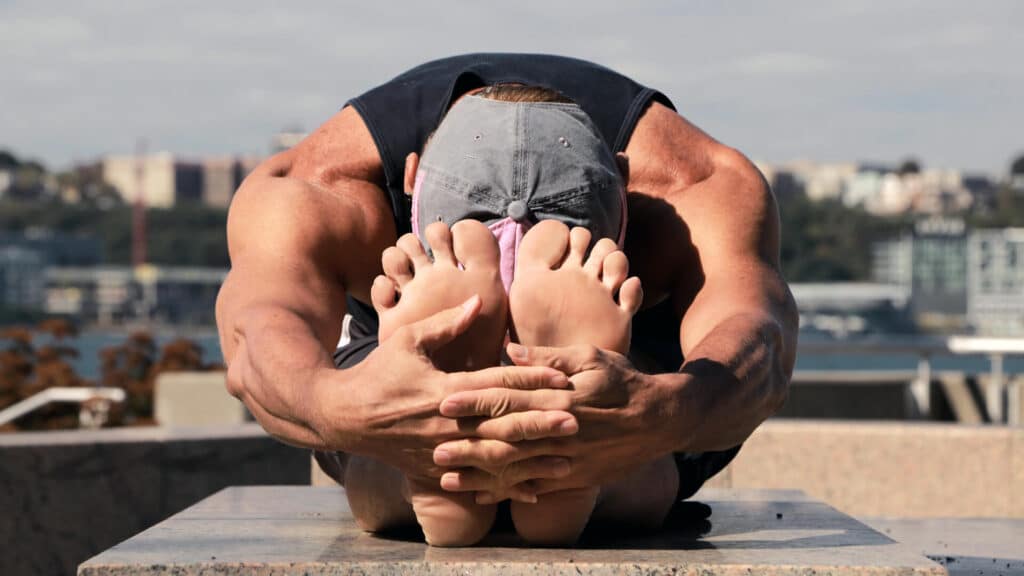
For example, when you engage your quadriceps, hip flexors, and biceps by grabbing the outside of your feet with both hands to assist a seated forward fold, you’re performing an active static stretch for the hamstrings.
This type of stretch triggers a powerful neuromuscular response called reciprocal inhibition — when the nervous system signals the stretched muscle to relax because its opposite is contracting. It’s not just stretching — it’s communication between your brain and muscles.
Active static stretching builds body awareness, control, and functional range. You’re not just lengthening tissue — you’re teaching your system how to move more efficiently.
🔸 Passive Static Stretching
Passive static stretching is when you relax into a position and let gravity, your body weight, or an external force (like a strap or a partner) do the work.
A classic example is Child’s Pose (check our blog > click here), which offers a passive static stretch through the entire posterior chain. You’re not contracting anything — you’re letting go and allowing the tissues to release gradually.
This method helps calm the nervous system, reduce residual tension, and restore ease in your movement. It’s especially effective after intense training or as part of your recovery practice.
🟧 FACILITATED STRETCHING
When you want to go deeper than static work, facilitated stretching is where control meets science. It’s often used in mobility training to increase range and fine-tune neuromuscular response — and when done right, it’s a game changer.
This method involves contracting the same muscle you’re stretching — a concept known as proprioceptive neuromuscular facilitation (PNF). You’ll find it in advanced mobility work, athletic performance programs, and physical therapy sessions for good reason.
Here’s how it works: during an active stretch, you gently contract the muscle being stretched. That contraction triggers a protective mechanism in your nervous system — the Golgi tendon organ — which senses tension and responds by allowing the muscle to relax more deeply once the contraction ends.
That’s the key. You’re not just forcing flexibility — you’re using your body’s natural feedback loop to create it.
Because this technique generates tension within the muscle, it also increases joint reaction forces. So, precision matters. Always use gentle contractions — around 30–50% of your maximum effort — to avoid unnecessary stress on the joints.
A great example is a Supine Hamstring Stretch with a Strap. Lift one leg toward the ceiling, keeping the other grounded. Gently press your heel into the strap to contract the hamstring for a few seconds, then exhale and release deeper into the stretch. Each round builds awareness, balance, and real mobility — strength and stretch working together in perfect coordination.
Facilitated stretching builds not just range, but control inside that range. It teaches your nervous system that deeper positions are safe — and that’s how real mobility happens.
🟧 DYNAMIC STRETCHING
Dynamic stretching is all about movement with intention — you take your muscles and joints through a controlled range of motion, actively exploring and expanding it. Unlike static stretching, you don’t hold; you move. Every rep builds rhythm, coordination, and readiness.
These movements increase blood flow, elevate temperature, and improve the elasticity of muscles and connective tissue, making them an ideal bridge between mobility work and performance training. Dynamic stretching is how you wake up your body before performance.
The key is to keep your movements smooth and mindful — not ballistic or forced. You want control, not chaos. Think of your joints as moving in fluid arcs, not jerky swings.
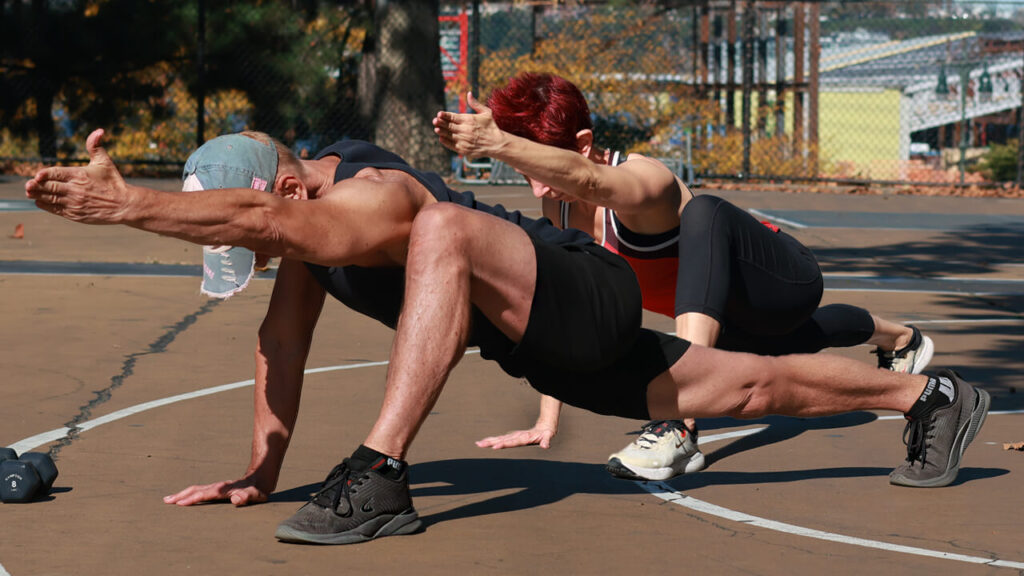
A great example is the World’s Greatest Stretch (check out WGS > click here) — step into a low lunge, rotate through your thoracic spine, lower the opposite arm (or play with same side arm) of the front leg towards the floor, then reach your arm overhead. Repeat a few times then switch sides. Every repetition mobilizes multiple joints and muscles in sequence, syncing breath, balance, and movement.
This kind of training not only prepares your body for action but also teaches it to transition gracefully between ranges. It’s the difference between flexibility and usable mobility — flexibility that performs.
🟧 ACTIVE STRETCHING
Active stretching is where strength meets control. You use your own muscles — not external assistance — to create the stretch. One group of muscles contracts to stretch the opposing group. It’s effort-based, precise, and builds lasting mobility you can actually use.
This type of stretching improves neuromuscular coordination and teaches your body how to stabilize at the end range — where most injuries happen and where real performance gains begin. You’re not just hanging out in a stretch; you’re training your nervous system to own that position.
A great example is a Straight-Leg Lift in a Seated Position — sit tall, engage your quads, and slowly lift one leg while keeping your spine long and core active. As you lift, your hip flexors work while your hamstrings lengthen under control. It’s a small but powerful move that builds mobility with strength and intention.
Active stretching is a cornerstone in our mobility and strength training because it creates usable range, joint stability, and body awareness. It’s the bridge between flexibility and function — movement that makes you strong, agile, and adaptable.
🟧 PASSIVE STRETCHING
Passive stretching is the most common form — and often the most misunderstood. It’s when an external force helps you move deeper into a stretch: gravity, a strap, a wall, or even a partner. You’re not using active muscle engagement to create the stretch — you’re allowing the body to let go and release tension gradually.
This type of stretching is ideal for cooldowns, recovery days, or moments when you want to restore balance after intense training. It calms the nervous system, improves circulation, and enhances your body’s ability to recover and reset. Think of it as giving your system permission to relax rather than forcing it to change.
A simple example is the Pretzel Stretch — lie on your side and bend your bottom leg back for stability, holding that foot with your top hand. Keep your top leg straight and bring it forward in front of you, grabbing your ankle with your bottom hand.
This position creates a full-body stretch with thoracic rotation. You’re not pulling hard; you’re letting time, breath, and gravity do the work.
Or in Yoga — Supta Baddha Konasana (Reclined Bound Angle Pose) — lying on your back with the soles of your feet together and knees falling open. Supported by props or simply the floor, your hips release gradually, your breath deepens, and your body learns to let go.
We use passive stretching as part of a recovery ritual — your reset button. It helps release residual tension, calm the nervous system, and bring your body back into alignment after effort. Remember, it’s not about how far you go, but how consciously you arrive there.
By implementing passive stretching, you complete the full spectrum of mobility training — from strength-based control to restorative balance.
🟧 BRINGING IT ALL TOGETHER
Stretching isn’t a single move or a one-size-fits-all approach — it’s a toolkit. Static, facilitated, dynamic, active, and passive stretches each have a role, and when used together, they create strength, control, and usable range.
Think of it like this:
Dynamic stretches wake up your body and prepare it for action.
Active stretches teach control and stability through full ranges.
Facilitated stretches use reflexes to go deeper safely.
Passive stretches restore, relax, and reset your system.
The magic happens when you combine them intelligently — building mobility that performs in real life.
For athletes, this means moving with precision, power, and confidence — whether you’re lifting, sprinting, twisting, or flowing through complex movement patterns.
Integrate these stretches into your routine consistently, respect your body’s signals, and watch your movement quality, performance, and recovery level up.
Stretching becomes more than a cooldown — it becomes a foundation for every move you make.
If you want to take this idea further and really understand how stretching fits into your movement practice, check out our next article — Mobility vs. Flexibility: Why You Need to Train Smarter.
It breaks down the difference between being flexible and being truly mobile — and why building control inside your range is what makes the real difference for athletes and movers alike.