








Core Control Meets Smart Shoulder Stability
If you’ve done regular dead bugs before, you already know they’re not just “abs” — they’re about control.
The Dead Bug with Resistance Band Pull takes that control a step further.
By adding resistance overhead, you challenge your shoulders, torso, and deep core to stay steady — while your legs move independently.
It’s simple. It’s sneaky. And it teaches your body something incredibly valuable:
Move one part — without losing control everywhere else.
🟧 What This Exercise Is
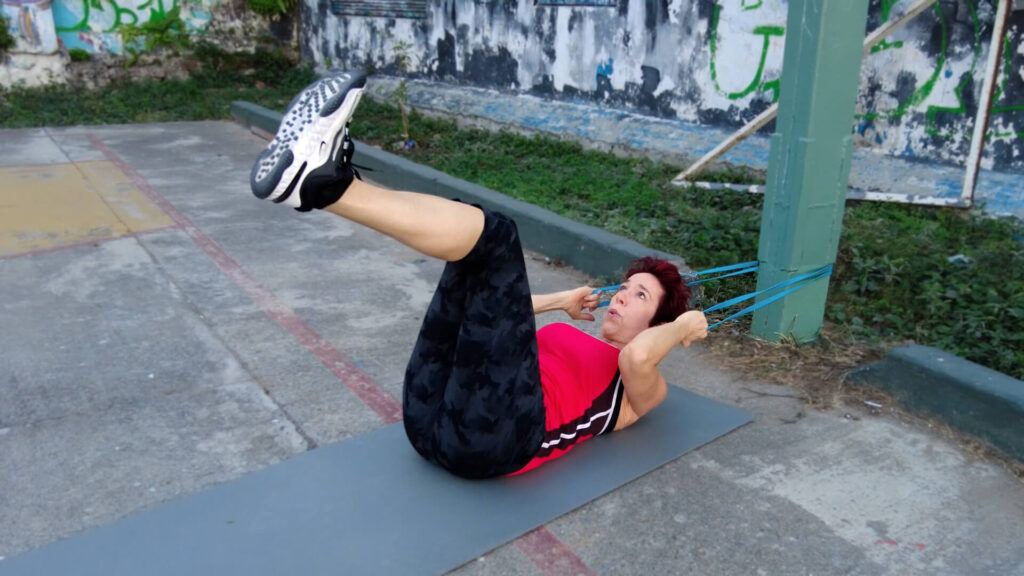
Let me explain. You lie on your back, knees bent in tabletop, arms straight up holding a resistance band that’s anchored overhead.
As one leg lowers toward the floor, you gently pull the band to create tension — while keeping your ribs down and your lower back grounded.
Equipment you need:
resistance band
door anchor, pole, rack, or cable attachment
You should feel:
deep core (not your lower back)
ribs gently pulling downward
light work through shoulders and lats
steady breathing — not straining
No pinching, arching, or gripping in the neck.
Just organized, controlled movement.
🟧 Why Dead Bug with Resistance Band Pull Matters
This variation blends several important training concepts at once:
Anti-extension control
You resist the urge to arch the lower back when the leg drops — teaching the core to stabilize instead of reacting late.
Shoulder + core integration
The band brings the lats and upper back into the picture — without loading the spine — which carries over to:
overhead lifts
handstands
planks
pressing movements
everyday posture
Coordination & awareness
You slow down, feel the movement, and organize the body under resistance — perfect for real-life situations and sport.
🟧 How to Do It — Step by Step
1. Setup
Attach the band overhead (door, rack, or machine).
Lie on your back.
Knees bent to tabletop (90° at hips and knees).
Arms straight up, hands holding the band.
Create light tension — not max effort.
2. Movement
Inhale to prepare.
As you exhale, slowly lower one leg toward the floor.
Gently pull the band toward your hips.
Return with control.
Alternate legs.
Move slowly — about 2–3 seconds down, 2–3 seconds up.
3. Breathing
Your breath drives the control:
Exhale as the leg lowers.
Let the ribs soften down.
Keep the belly from bulging.
If your breath stops, the load is too heavy — or you’re moving too fast.
🟧 What to Avoid
Common mistakes:
❌ Lower back lifting off the floor
❌ Pulling the band too aggressively
❌ Legs dropping too low too soon
❌ Rushing the reps
❌ Shoulders creeping toward the ears
If you feel your low back, neck, or hip flexors doing the work — reset, slow down, and shorten the range.
🟧 Variations & Progressions
Start where you can maintain clean movement.
Beginner
Light band
Shorter range
Focus on breathing + control
Intermediate
Full range
Small pause at the bottom
Even tempo throughout
Advanced
Heavier band
Slower tempo (3–4 seconds)
Extend the opposite arm overhead while the leg lowers
Progression rule: control first — load second.
🟧 Where This Fits in Your Training
Use it as:
warm-up before strength training
core block during strength days
prep work for overhead lifting and plank variations
stability training on recovery days
Programming idea:
3–4 sets of 8–12 slow reps per side
Stop 1–2 reps before control starts to fade.
🟧 Final Thought
The Dead Bug with Resistance Band Pull builds:
deep core strength
shoulder stability
awareness and control
a stronger connection to your breath
Those qualities follow you into lifting, running, yoga, dance — and any other sport you do.
Once your core knows how to stabilize, your upper body can really go to work.
We have a great article for you: Decline Push-Ups — the upper-body game-changer.