







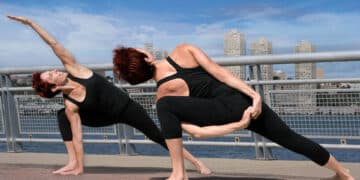




There’s a moment in the Flying Split where everything clicks. Your arms lock in, your core tight, and your body hovers a few inches off the ground — suspended between power and precision. It’s strength flowing through every muscle, balance coming from control, and focus sharpening with every breath.

You don’t stumble into this one. You earn it.
The Flying Split — or in yoga: Eka Pada Koundinyasana II — demands total-body awareness. Shoulders that stabilize, wrists that carry weight, hips that open with purpose, and legs that extend like they’re meant to reach beyond limits.
This is movement stripped of everything unnecessary. It asks you to show up — strong, centered, and focused. Not just to perform, but to understand what your body is capable of when strength becomes expression.
🟧 What Makes the Flying Split Powerful
The Flying Split isn’t a pose you fake your way through. It exposes weaknesses, demands control, and rewards precision. Every part of your body has a job — if one link fails, the entire structure collapses.
Your shoulders stabilize like anchors, and your core becomes the hinge that holds everything together. Your arms aren’t just supporting; they’re actively pushing, balancing, and adjusting the micro-movements you need to stay afloat.
The forward leg presses into your triceps, firing hip flexors and quads. The back leg extends straight and strong, demanding glute and hamstring engagement. It’s a constant interplay between tension and length, power and control.
This pose challenges how well your strength translates into balance, how efficiently your body communicates under pressure, and how much focus you can sustain when everything inside you wants to give in.
🟧 Building the Foundation
You don’t get into a Flying Split by accident. It’s built through strength, mobility, and body control. Before you lift off, you need to train the fundamentals that make this pose possible.
Start with your Chaturanga. If you can’t hold it with control — elbows over wrists, shoulders aligned — you’re not ready. The Flying Split lives in that same structure: bent arms, core engaged, chest slightly forward. Without that base, you’re forcing shape instead of creating power.
Next, work on your hip mobility and hamstring length. One leg reaches forward, the other drives back. That separation requires flexibility and strength through the full range — not passive stretching, but active control.
Then comes core intelligence. This isn’t crunches. It’s about deep stability — locking your midline while limbs move independently. Hollow-body holds, plank variations, and controlled leg extensions keep you steady when gravity pulls forward.
Finally, train your arm balance mechanics. Use blocks or low lifts to practice shifting weight into your hands and feel your scapulae, triceps, and fingers working as one system. Start with Crow Pose to build a solid base. The more familiar your nervous system becomes with that balance point, the more natural flight feels.
Practice these preparatory drills 3–4 times per week, focusing on control and precision rather than volume. Warm up wrists and shoulders carefully; alignment is critical to prevent overload and injury.
The Flying Split rewards those who train smart — not just hard. Effort looks effortless because it’s earned through precision and patience.
🟧 Why It Matters
The Flying Split isn’t about showing strength — it’s about owning it. When you control your body in space, suspended by your own power, you’re integrating strength, mobility, focus, and breath in one amazing pose.
You learn to generate power from your center, channel it through your limbs, and stay calm when intensity peaks.
It strips away what’s unnecessary. It exposes weakness, imbalance, hesitation — then teaches you to correct it. You build resilience not by pushing harder, but by moving smarter.
This is a full-body test of coordination, focus, and applied strength — the kind every serious mover, athlete, or performer can learn from.
🟧 Training Approach
Start with your foundation — Chaturanga. If elbows flare, core collapses, or shoulders roll forward, you’re not ready to fly. You need a stable “shelf” with your arms and upper back, built through pushing power through your palms, engaging your lats, and locking your midsection.
Focus next on hip mobility and hamstring flexibility. The forward leg demands length and active control; the back leg requires extension without collapsing the lower back. Dynamic splits, lunges, and resisted hip openers build the range you need.
Add core and rotational strength. The Flying Split is a twist at heart: your torso rotates, weight shifts diagonally, and core fires as your legs move in opposite directions. Hollow-body holds, side planks, and resistance band rotations help build this intelligence.
Progress gradually. Before attempting the full arm balance, master preparatory drills like Crow Pose jumps, Lizard Pose with twist, and knee-to-tricep Chaturanga transitions. Each drill reinforces structure and focus.
When you go for it, approach with intention. Lead with strength, not momentum. Keep gaze slightly forward, core engaged, energy drawn from your center. The pose doesn’t happen to you — you make it happen.
🟧 The Final Word
The Flying Split is about owning your strength. It’s a statement of control: lift your body, stabilize your weight, and extend with precision. It’s raw, functional power refined through discipline.
This isn’t a pose you can fake. Every muscle, joint, and breath must participate. The same principles that make you stronger in the gym — stability, mobility, and focused effort — apply here. In this pose, strength becomes expression.
It’s not about how high you lift or how far you split — it’s about how well you connect the pieces. When you train, don’t just chase the pose. Build the body and mindset that make it possible.