











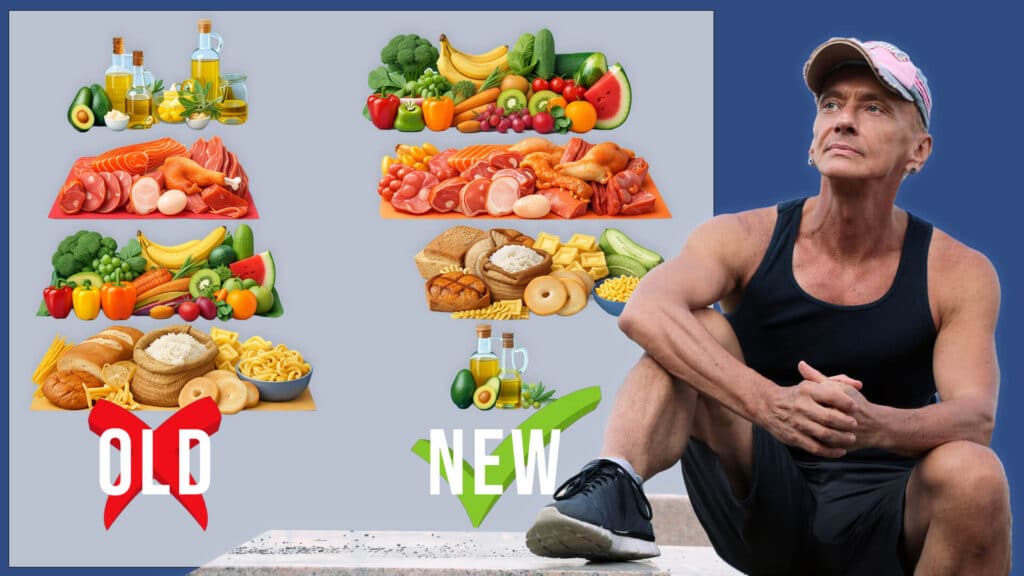
The Food Pyramid – for the first time in decades, the government didn’t just adjust the official U.S. dietary guidelines. They flipped them.

I’ve been watching these guidelines for a long time, and honestly, I always wondered when this would finally happen. For over 40 years, the foundation stayed the same. More grains. Less fat. Count calories. Trust the system.
Now, that foundation is cracking, and that matters to all of us more than you might think.
These guidelines don’t just sit in a government document. They shape public nutrition programs. They influence what food companies make, how they market food, and what they label as “healthy.”
When the rules change, the food system has to change with them.
🟧 What You’ve Been Told for Decades
For a long time, the message was clear and simple.
Base your diet on carbohydrates. Eat six to eleven servings of grains every day. Choose low-fat foods. Avoid cholesterol and saturated fat. And if your weight went up, the explanation was always the same: too many calories. Right?
On paper, that sounded reasonable.
In real life, it didn’t work at all.
During the decades people followed these guidelines, obesity rates, type 2 diabetes, fatty liver disease, and metabolic problems increased steadily. Even people who trained hard and “ate clean” often struggled with energy, recovery, and blood sugar swings.
So clearly, something went wrong.
🟧 The Big Shift: Flipping the Pyramid
This time, they didn’t just adjust the numbers.
Instead of tweaking recommendations, the new guidelines changed the conversation. For the first time, ultra-processed foods were directly called out as a major driver of chronic disease. Not sugar alone. Not calories alone. The food itself.
That’s a huge step in the right direction.
Ultra-processed foods now sit in the crosshairs, while real, whole foods are pushed to the front. Grains are no longer the base of the diet. They no longer represent the default fuel in the new food pyramid.
That’s a massive break from what we’ve been told for decades.
🟧 Protein Moved Up
One of the most important changes is the view on protein.
The old recommendation was about 0.8 grams of protein per kilogram of body weight. For an average adult, that often meant around 60 to 70 grams per day. That amount might keep you alive, but it doesn’t support strength, recovery, or long-term muscle health very well.
The new recommendation is much higher—around 1.2 to 1.6 grams per kilogram of body weight.
For someone who trains, that difference is huge.
Protein isn’t just about muscle. It helps stabilize blood sugar, supports hormones, improves recovery, and helps you maintain lean tissue as you age. In my experience, most active people are under-eating high-quality protein without realizing it.
Changing that alone can improve how you feel, how you train, and how you recover.
🟧 Ultra-Processed Foods and the Problem With the Word “Food”
One of the most important ideas in the new guidelines has nothing to do with macros.
It has to do with definitions.
Right now, the legal definition of food is simple: something edible that can sit on a shelf. That definition has nothing to do with whether it supports life, repairs tissue, or improves health.
Biologically, food should do those things.
If something can’t help your body grow, repair, or function better, it may be edible—but that doesn’t mean it deserves to be called food. Ultra-processed products are designed for convenience, greed, and profit—not nourishment.
Here’s a simple shift that makes food choices clearer:
Stop asking, “Is this allowed?” and start asking, “What does this do in my body?”
🟧 What the Guidelines Still Don’t Talk About
Even with all these improvements, the guidelines leave out something important.
They don’t directly address insulin resistance.
Food quality matters. But how often you eat matters too. If you’re constantly grazing—even on “healthy” foods—insulin stays elevated. Over time, that makes it very hard to restore metabolic health.
Therefore, it is important to understand the following: changing food choices helps prevent problems. However, it doesn’t always reverse them.
That doesn’t mean the new guidelines are useless; it means they’re incomplete. And knowing that gives you an advantage.
🟧 The Confusing Parts: Fats, Oils, and Refined Carbs
Some areas still need improvement.
There is still a cap on saturated fat, even though foods like red meat and full-fat dairy are still on the list as nutrient-dense options. Seed oils and refined oils are mentioned but not clearly explained, and there is barely a word about industrial starches—which act like hidden sugars in the body.
This can feel confusing if you’re trying to eat well.
The key is context. Whole foods behave differently in the body than refined ones. Heavily processed oils that are stored for long periods oxidize easily. Refined starches raise blood sugar fast, even when they’re labeled “sugar-free.”
While I didn’t write this article to chase perfection, I wrote it to make you think, understand, and make better choices.
🟧 What This Means for You, Right Now
You don’t need to wait for institutions to catch up.
Prioritize real food today. Eat enough protein to support your training and recovery. Reduce ultra-processed foods instead of trying to “balance” them. Pay attention to how often you eat, not just what you eat.
This isn’t about following another set of rules.
It’s about moving forward and knowing.
🟧 A Bigger Picture Worth Paying Attention To
Nutrition science evolves. What was once treated as unquestionable truth changes when evidence stacks up. This update is a signal that decades of advice didn’t work the way it was supposed to.
That doesn’t mean you should blindly follow the new guidelines either.
It means you should look closer at your own choices. Ask better questions. Eat food that actually supports the body you train and live in.
If this shift does anything right, it should make you stop outsourcing your health to charts, ads, and slogans—and start paying attention to what food really does.
The guidelines changed. The real question is whether we’re ready to change too.
Information is only useful if it leads to action.
Knowing what to eat matters, but doing the work consistently matters more.
That’s where the real difference is made.
In the next article, we shift from food to behavior — > Motivation vs. Determination, and why waiting to “feel ready” keeps most people stuck.