


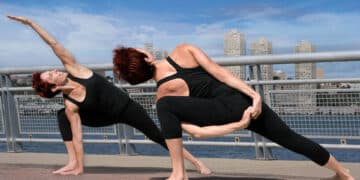
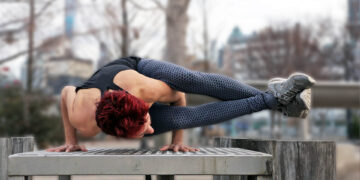



At first glance, Bound Side Angle Pose and Extended Side Angle Pose couldn’t look more different — one compact and rooted, the other long and expansive.
But when you look closer: both share the same foundation — strong legs, stable hips, and a connected core.
It’s the upper body expression that changes everything — one asks you to reach outward, the other to rotate inward.
Both poses are built on the same principle — grounded strength, aligned structure, and breath-driven control. Understanding that connection sharpens your practice and brings purpose to how you move.
🟧 The Shared Foundation
Both poses start from the same base — the power of your lower body.
Your legs, hips, and core create the stability that everything else depends on.
From the ground up, the structure doesn’t change: a deep lunge, the front knee stacked over the ankle, the back leg extended and strong, the hips anchored and stable.
Your lower body creates the platform that everything else grows from — power, alignment, and balance.
Whether you extend your arm overhead or bind it behind your back, the foundation stays the same. Your legs drive stability, your hips control rotation, and a strong core connects the two halves of your body. That’s the real strength of both poses — not the shape itself, but the integration underneath it.
🟧 Different Upper Body Stories
What separates the two versions isn’t the base — it’s the upper body story.
In Extended Side Angle Pose, you lengthen and expand. Your top arm stretches overhead, lengthening through the side waist, ribs, and up to your fingertips.
The chest opens, the ribs lift, and you find strength through reach and breath.
It’s a pose where energy moves outward, and strength meets length.
In Bound Side Angle Pose, the direction changes. Instead of reaching, you contain and connect. The energy turns inward. The bind draws your arm behind the back, rotates the shoulder, opens the chest in a different way — and draws your awareness deeper into the pose.
This variation builds mobility and control in your shoulders while demanding more from your balance, breath, and patience.
It’s less about length, more about integration. You build mobility in your shoulders, coordination through your torso, and control through breath and balance.
Both poses challenge your body differently — one through reach and lift, the other through rotation and depth — but both cultivate the same qualities of awareness, discipline, and strength.
🟧 Why It Matters
Understanding the link between these two poses changes how you train and how you move.
When you realize that different shapes grow from the same foundation, you train smarter. You stop moving through poses mechanically and start feeling how strength and mobility work together.
Both variations teach you control, but in different ways:
Extended Side Angle teaches you how to open — to expand your reach, breathe fully, and connect strength with space.
Bound Side Angle teaches you how to stabilize — to rotate with purpose, contain your strength, and stay composed under pressure.
When you practice both, you develop a complete kind of strength and control — grounded, adaptable, and intelligent.
Final Word
Both versions of Side Angle Pose challenge you — just in different ways.
One opens. The other binds. Both demand focus, precision, and control from the same foundation of grounded legs, steady hips, and an active core.
If you only practice one, you miss half the story.
Learning to move between extension and containment builds a deeper awareness of how your body connects strength with structure, and how your mind adapts under pressure.
So the next time you drop into Side Angle, ask yourself — do you need to reach or to bind?
Either way, you build power that’s functional, refined, and real.